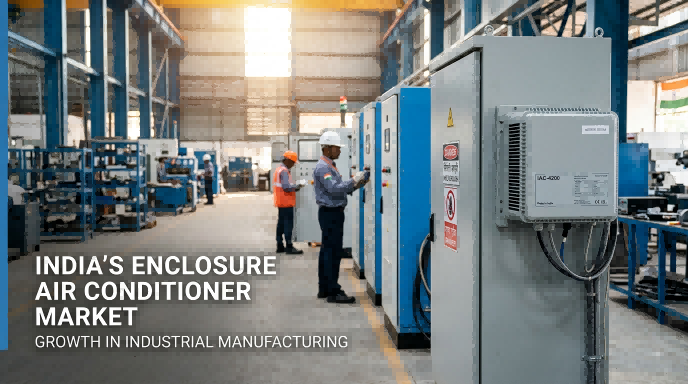
QINGDAO, China - India's enclosure air conditioner market is emerging as one of the fastest-growing segments in the global industrial cooling landscape, driven by rapid manufacturing expansion, extreme climatic conditions, and chronic power infrastructure challenges. With annual growth rates holding steady at 15-22%-outpacing the Southeast Asian average-the market presents both substantial opportunities and formidable barriers for international suppliers of industrial air conditioner solutions.
Demand Fundamentals: Strong, Urgent, and Demanding
The demand surge is anchored in India's Production Linked Incentive (PLI) scheme, a $24 billion initiative targeting 14 critical sectors including automotive components, renewable energy, food processing, pharmaceuticals, and water treatment automation. These manufacturing investments are driving parallel growth in factory automation control panel cooling and low-voltage distribution panels - the largest application segment for enclosure cooling unit deployments. Meanwhile, outdoor cabinet air conditioner systems for telecom shelters, photovoltaic inverter enclosures, and EV charging station thermal management represent high-growth verticals, with telecom enclosure cooling for outdoor base stations and pharmaceutical precision control panels leading premium project demand. Overall, electrical cabinet cooling remains the most voluminous and sustained requirement across all end-user industries.
However, what truly distinguishes the Indian market is its uniquely harsh operating environment. Summer temperatures across large parts of the country routinely reach 45-50℃, with parts of Rajasthan exceeding 51℃ in 2026. In 2024 alone, India recorded 554 heatwave days - more than double the 230 reported the previous year. Industrial customers now prioritize enclosure air conditioner units rated for maximum ambient temperatures of at least 55℃, as standard European-spec 45℃models-often marketed as general-purpose cabinet air conditioner units-frequently overheat and trip in Indian factory conditions, where indoor ambient temperatures hover around 45℃. This has created a distinct sub-category for high-temperature cooling unit designs tailored specifically for South Asian climates.
Compounding the thermal challenge is severe power quality instability. Voltage fluctuations across India's industrial corridors are notorious, with supply often deviating beyond the CEA's permissible ±10% to -15% range. Frequent short-duration outages and voltage sags cause PLC resets, VFD trips, and premature compressor failures-pushing customers to demand wide-voltage startup capability, robust overload protection, and surge immunity as non-negotiable features for every enclosure cooling unit deployed in the region. Many projects now pair control cabinets with UPS systems, indirectly raising the reliability bar for industrial air conditioner products even further. Heavy dust loads in many industrial clusters add yet another layer of product engineering complexity.
Market Landscape: A Three-Tier Competitive Structure
The competitive landscape is sharply stratified by price and positioning.
Tier 1 - Premium Multinationals: Rittal, Schneider Electric, Vertiv, and STULZ dominate large-scale project tenders, leveraging their strong ties with European electrical cabinet cooling OEMs and multinational plant contractors. Their advantages come with significant trade-offs: long lead times, premium pricing, and limited accessibility for small-to-medium enterprises.
Tier 2 - Local Indian Manufacturers: Companies such as Connectwell, Adhunik Powertech, and Ninaee Electrical, along with numerous small assemblers, serve as the mid-market backbone. Their typical model involves procuring compressors, controllers, and heat exchangers from third-party suppliers for local assembly, resulting in limited in-house R&D capability. While they offer competitive pricing, local stock availability, and rapid after-sales response, product consistency under high-temperature conditions and component durability remain common concerns for their cabinet air conditioner offerings.
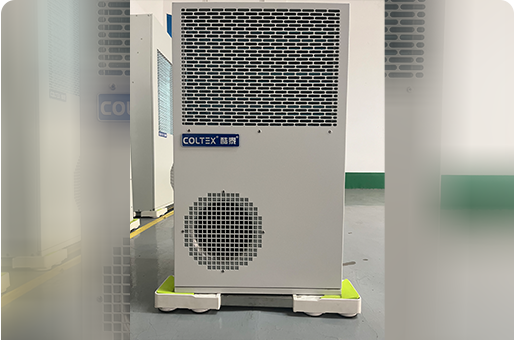
Tier 3 - Chinese Import Brands: A growing number of Chinese enclosure air conditioner manufacturers are entering the market through distributors in Delhi, Mumbai, and Pune. Their value proposition centers on performance comparable to Tier 1 brands at significantly lower price points. However, most face hurdles including limited BIS certification coverage, insufficient local inventory, thin after-sales networks, and implicit trade resistance from India's "Make in India" policy framework.
Market Dynamics in Transition
The market is currently witnessing a three-way realignment: small-to-medium projects are increasingly replacing expensive Tier 1 brands with Chinese alternatives, local assemblers are consolidating their hold on the low-end segment, and Chinese industrial air conditioner products are steadily capturing the mid-tier incremental market. As industrial automation penetration deepens-India's automation market is projected to grow from USD 17.28 billion in 2025 to USD 38.02 billion by 2031-the demand for reliable, cost-effective enclosure cooling unit solutions will only intensify. The winners in this race will be those who can engineer high-temperature cooling unit systems for 55℃ tolerance, voltage instability, and dusty environments while building local service infrastructure to match-ensuring that every outdoor cabinet air conditioner and telecom enclosure cooling installation performs reliably in the harshest Indian conditions.